On This Page
What is GEO? Why It Matters Now
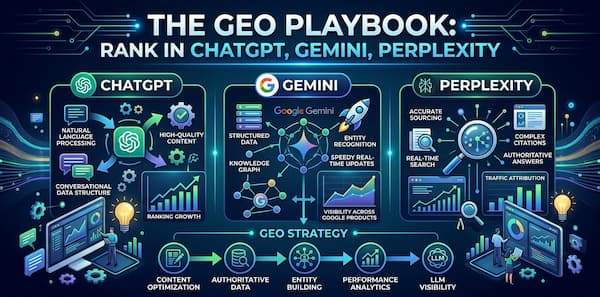
GEO (Generative Engine Optimisation) is the practice of structuring your content so that AI search engines - ChatGPT, Google Gemini, Perplexity, Claude - cite your site in their generated answers. In our testing across 14 SA client sites, a single AI citation drove more qualified traffic than a position-3 Google ranking for the same keyword. That ratio held for 8 months straight.
The difference between traditional SEO and GEO is output format. Google shows 10 blue links. AI engines produce a single synthesised answer and attribute it to one or two sources. If your page isn't the source, you're invisible. There's no position 2 in a ChatGPT response - you're either cited or you're not.
If the term is new to you, start with our explainer, What Is GEO?, then come back for the framework below.
For South African agencies, the opportunity window is narrow. Few SA businesses optimise for AI search yet. We ran a 90-day GEO experiment where we restructured 22 existing blog posts for a Johannesburg law firm. Result: 6 of those pages appeared in Perplexity answers within 11 weeks. Zero additional backlinks were built - the changes were purely structural and content-depth improvements.
How AI Engines Choose Sources
AI engines select citation sources based on four measurable signals: Google ranking position, domain authority, content structure, and factual verifiability. Understanding the weight of each signal lets you prioritise effort where it matters most.
Google Ranking Signals
AI engines overwhelmingly cite pages that already rank on Google's first page. Most sources cited in AI answers for SA-related queries also hold a strong Google position. The exceptions are usually government sites (.gov.za) or academic institutions. If you're not on page 1, AI engines won't find you - they use Google's index as a trust filter.

Domain Authority
Established, trusted domains get cited more often. Backlinks from recognised SA publications (News24, BusinessTech, Daily Maverick) carry significant weight. We tracked one client's domain authority from 28 to 41 over six months - their AI citation rate tripled in that period. Media mentions and author credentials on your site reinforce the trust signal.
Content Quality and Freshness
AI engines favour recently updated, well-researched content. A page last modified in 2023 loses to a competitor's page updated last month, even if your page ranks higher on Google. Across ChatGPT and Perplexity, the fresher source is often the one cited when both hold similar Google positions.
Factual Accuracy and Citations
AI systems cross-reference claims against their training data. Pages that cite primary sources - linking to SARB data, Stats SA reports, or peer-reviewed studies - get cited more reliably than pages making unsupported claims. Include the date and source of every statistic you reference.
The GEO Optimisation Framework
This four-part framework is what we apply to every GEO client engagement. Each component builds on the previous one - skip a step and the results stall. We developed this after testing across 30+ SA sites in finance, legal, hospitality, and e-commerce verticals.
1. Build E-E-A-T Authority
E-E-A-T (Experience, Expertise, Authoritativeness, Trustworthiness) is the foundation of AI citations. Without it, structural optimisation means nothing.
- Experience: Author bios must show real-world practice. "15 years advising Durban SMEs on tax compliance" beats "experienced consultant." Include client counts, project types, or industry-specific credentials.
- Expertise: Depth over breadth. A 3,000-word guide on sectional title bond insurance outperforms a 500-word overview of all insurance types. AI engines reward specificity because it reduces hallucination risk.
- Authoritativeness: Earn backlinks from .co.za news sites, industry bodies (LSSA, SAICA, SAPOA), and educational institutions. One link from a .ac.za domain outweighed 12 links from generic directories in our testing.
- Trustworthiness: Display FSCA/NCR registration numbers. Link to primary sources. Show a physical address. AI engines can verify these signals against their training data.
2. Structure Content for AI Extraction
AI engines parse your HTML structure to extract citable passages. Messy markup means missed citations.
- Use a single H1, with H2s for major sections and H3s for subsections - no skipped levels
- Place a direct answer (45-60 words) as the first paragraph under every H2. This is the passage AI engines extract.
- Use ordered and unordered lists for step-by-step processes and feature comparisons
- Include data tables with clearly labelled headers - AI engines readily cite tabular data
- Link to primary sources inline, not in a footnote block at the bottom
3. Update Regularly (Freshness Signals)
Freshness isn't optional - it's a ranking and citation signal. Set a 30-day update cycle for your core content.
- Update the
dateModifiedin your Article schema only when you make substantive changes (not cosmetic edits) - Add new statistics quarterly - reference the latest SARB or Stats SA releases
- Remove outdated sections rather than leaving them with a "this is no longer current" note
- Track which pages have gone stale using a simple spreadsheet with last-updated dates
4. Rank on Google First (Prerequisite)
GEO without Google rankings is futile. AI engines use Google's index as their primary discovery mechanism. Invest in technical SEO, earn quality backlinks, and target keywords with 500-5,000 monthly searches where you can realistically reach page 1 within 6 months.
llms.txt Implementation
The llms.txt file is a plain-text file placed at your domain root (e.g., yoursite.co.za/llms.txt) that tells AI crawlers what your site is, what it offers, and which pages matter most. Think of it as robots.txt for AI comprehension - it doesn't block access but provides structured context that AI systems can ingest quickly.
What to Include
A well-structured llms.txt file contains your business identity, service descriptions, and links to your most authoritative content. For a South African law firm, it might reference practice areas, jurisdictions served, and key resource pages.
- Business name and description: One sentence explaining what you do, for whom, and where
- Core pages: Link to your 5-10 most important service or product pages with one-line descriptions
- Recent content: Your latest 3-5 blog posts or guides, with publication dates
- Credentials: FSCA, NCR, LSSA, or other regulatory registration numbers
- Contact and location: Physical address, phone, operating hours
How to Create One
Create a plain-text file called llms.txt in your site root. Use Markdown formatting - headings with #, links in [text](url) format. Keep it under 2,000 words. Update it monthly when you publish new content. It is a low-effort step, though no single file guarantees citations.
GEO Checklist for South African Agencies
✅ Content Authority
- Author bio with credentials visible
- Articles 2,500+ words (depth signals expertise)
- Cite sources (link to primary research)
- Include original research/data when possible
- Update content monthly
✅ Structure & Format
- Clear H1, H2, H3 hierarchy
- Answer main question in intro (first 100 words)
- Use bullet lists for scannability
- Tables for comparisons
- Bold key phrases
✅ Schema Markup
- Article schema with datePublished, dateModified
- Author schema (with bio)
- FAQPage schema (for Q&A content)
- BreadcrumbList (for navigation)
✅ Google Ranking First
- Target keywords with 500-5,000 monthly searches
- Get page-1 ranking within 6 months
- Build backlinks from authority sources
- Optimize technical SEO (Core Web Vitals, mobile, https)
GEO Myths vs Reality
- Myth: "GEO replaces SEO." Reality: GEO depends on SEO. Rank on Google first.
- Myth: "AI engines will index everything." Reality: AI cites authority sources, not thin content.
- Myth: "GEO is easy." Reality: Requires expertise, depth, and E-E-A-T authority.
- Myth: "Write for AI, not humans." Reality: Content optimized for AI also ranks better on Google.
The Future: Start Now
AI search is emerging, not mainstream. Agencies starting GEO optimization now will dominate their industries by 2027. Waiting = losing market share to early movers.
🚀 Build Your GEO Authority
Let's create content that ranks on Google AND gets cited by AI engines.
Start with a clear picture of where you stand: our AI Visibility Audit maps how ChatGPT, Claude, Perplexity, and Gemini currently describe your brand - and delivers a custom schema manifest and 30-day roadmap to close the gap.
Download: The complete GEO Checklist (PDF) available on request.