On This Page
Want this handled for your property? This guide covers the strategy - but if you'd rather have specialists do it, our SEO service for hotels & guest houses builds your destination pages, Google Business Profile, and direct-booking optimisation for you. Every engagement starts with a free audit.
Why Hospitality SEO Matters in South Africa
South Africa's hospitality sector - hotels, guesthouses, B&Bs, lodges, and restaurants - depends on search visibility more than almost any other industry. Most travellers research accommodation online before booking, and most of those journeys start on Google. If your property doesn't appear in the first few results for terms like "guesthouse in Stellenbosch" or "boutique hotel Cape Town", you're handing bookings to competitors or to OTAs that charge a commission on every reservation.
Properties that invest in their own SEO can reduce their dependence on OTAs over time. That's real money. As an illustration: a 30-room guesthouse with an R800 average nightly rate that pays an assumed 18% commission on half its bookings is giving away roughly R52,000 per month. Shifting a share of those bookings to direct channels through organic search can pay back a lot of SEO work.
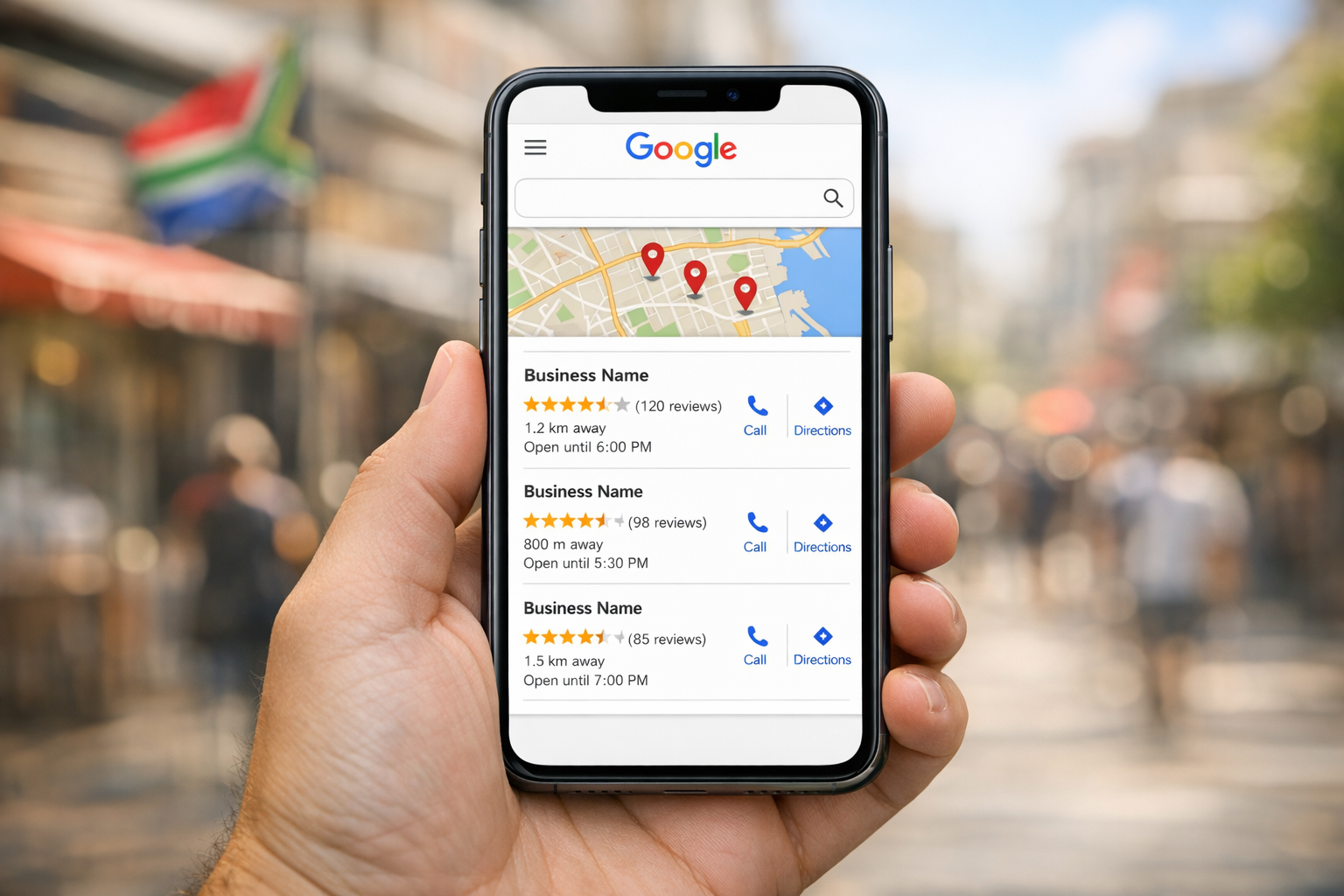
The hospitality market in SA is also fiercely local. A safari lodge near Kruger competes differently from a beachfront hotel in Umhlanga or a wine farm stay in Franschhoek. Each property needs location-specific keyword targeting, locally relevant content, and a Google Business Profile that reflects what guests actually search for.
Seasonal Search Patterns for SA Tourism
Search demand for South African hospitality follows distinct seasonal peaks that directly affect when and how you should invest in SEO content. The December-January summer holiday window generates the highest search volume, with queries like "holiday accommodation South Africa" spiking well above the annual average from mid-October onward. Easter week produces a secondary peak, particularly for KZN coastal properties and Garden Route stays.
A guesthouse can publish seasonal landing pages (summer holidays, Easter getaway, Comrades Marathon weekend, Midmar Mile) months before each event, so they are ranking when the searches spike.
Major sporting events also create spikes worth targeting. The British & Irish Lions tour in 2025 drove massive search volume for "accommodation near Cape Town Stadium" and similar queries. World Cup rugby, international cricket, and the Comrades Marathon all produce predictable, high-intent accommodation searches. Build event-specific pages 4-6 months in advance and update them annually - Google rewards pages with history and freshness signals combined.
International tourists searching from the UK, Germany, and the Netherlands often research 3-6 months ahead of their trip. This means your content targeting "South Africa safari lodge" or "Cape Winelands accommodation" needs to rank by June to capture the December/January booking window.
OTAs vs Direct Bookings: The SEO Battle
Booking.com, TripAdvisor, Expedia, and Google Hotels dominate the SERPs for generic hospitality queries in South Africa. These platforms spend billions on SEO and PPC globally, and you won't outrank them for head terms like "hotels in Cape Town". But you absolutely can outrank them for long-tail, location-specific, and experience-based queries that drive high-conversion traffic.
Target queries OTAs can't personalise. Examples:
- "Pet-friendly guesthouse Clarens Free State" - OTAs filter for this, but rarely create dedicated landing pages
- "Wedding venue accommodation Midlands KZN" - experience-based, specific to your offering
- "Self-catering near Kruger Phalaborwa gate" - micro-location targeting OTAs handle poorly
- "Load shedding backup power hotel Johannesburg" - SA-specific concern no international OTA addresses
Your website should also include a clear price-match or "book direct" incentive. Properties often lift direct booking conversion simply by adding a banner stating "Best rate guaranteed - book direct and save". Pair this with structured data (see schema section below) so Google displays your direct booking option alongside OTA listings in search results.

Google Business Profile for Hospitality
Your Google Business Profile (GBP) is the single most important local SEO asset for any hospitality business in South Africa. It controls what appears in the Map Pack, Google Maps, and the knowledge panel - all high-visibility placements that drive clicks and calls. A fully optimised GBP listing can generate a large share of a property's organic enquiries.
Reviews: Quantity, Quality, and Response
Google uses review signals as a ranking factor for local results. Properties with many reviews and a strong average rating tend to outrank competitors in the Map Pack. A simple post-checkout email sequence asking guests for a review is one of the most effective ways to grow both review volume and rating.
Respond to every review - positive and negative - within 48 hours. Google's local algorithm weighs owner responsiveness. Negative review responses should be professional, acknowledge the issue, and offer to resolve it offline. Never argue in public.
Photos and Virtual Tours
Listings with plenty of good photos tend to receive more direction requests and website clicks than those with only a few. Upload high-quality images of rooms, dining areas, pools, views, and surrounding attractions. Tag photos with descriptive alt text. Google 360 virtual tours are particularly effective for hospitality - they let potential guests "walk through" your property before booking.
GBP Posts and Q&A
Post weekly updates about seasonal specials, events, or local attractions. GBP posts appear directly in your listing and give Google fresh content signals. Use the Q&A feature proactively: seed your own common questions ("Do you have backup power during load shedding?", "Is the pool heated in winter?", "How far are you from the airport?") and answer them. This prevents incorrect answers from random users and adds keyword-rich content to your listing.
Booking Links
Enable the "Reserve" or "Book" button on your GBP listing. Google Hotels integration allows you to display real-time rates and availability directly in search results. Properties with active booking links tend to see more clicks from their GBP listing than those with only a website link.
Schema Markup for Hotels and Restaurants
Structured data tells Google exactly what your property is, where it's located, what it costs, and how guests rate it. Hotels and restaurants that implement schema markup correctly are eligible for rich results - star ratings, price ranges, and booking links displayed directly in the SERPs. Properties without schema miss these enhancements entirely.
Hotel Schema
Use the Hotel schema type (which extends LodgingBusiness) to mark up your property. Include these properties at minimum:
- name, address, geo - your property's full name and precise location
- starRating - your Tourism Grading Council of South Africa (TGCSA) rating
- priceRange - e.g., "R1200 - R3500" per night
- aggregateRating - pulled from your Google reviews
- amenityFeature - Wi-Fi, pool, parking, generator backup, etc.
- checkinTime / checkoutTime - formatted as ISO 8601 times
Restaurant Schema
Restaurants should use the Restaurant schema type with servesCuisine, menu (link to your online menu), acceptsReservations, and priceRange. If you offer both accommodation and dining, implement both schema types on the relevant pages - don't combine them into a single block.
Event Schema for Functions and Conferences
If your venue hosts weddings, conferences, or events, add Event schema to event-specific pages. This makes your venue eligible to appear in Google's event listings. Include location, offers (pricing), and maximumAttendeeCapacity.
Validate your schema at validator.schema.org before deploying. Properties can gain rich snippets soon after implementing correct schema, and Hotel schema with aggregateRating can lift organic click-through rate.
Load Shedding Impact on Hospitality Websites
Load shedding is a uniquely South African problem that directly affects hospitality SEO performance. When Eskom implements rolling blackouts, websites hosted on local servers without backup power go offline. Every minute of downtime costs you potential bookings - and if Googlebot crawls your site during an outage, it can temporarily deindex pages or lower your crawl priority.
We've written a detailed guide on how load shedding affects website performance in South Africa - read it for the full technical breakdown. The short version for hospitality businesses:
- Host with international or cloud providers. AWS, Cloudflare, or Hetzner's European nodes keep your site up regardless of the Eskom grid schedule.
- Use a CDN. Cloudflare's free tier caches your pages across global edge nodes. Even if your origin server goes down, cached pages remain accessible.
- Monitor uptime. Tools like UptimeRobot (free) or Pingdom alert you when your site drops. You can't fix what you don't measure.
- Turn load shedding into a selling point. Create content around "hotels with generator backup in [city]" and "load shedding-proof accommodation [area]". These are real search queries from both domestic and international travellers concerned about their stay.
International guests researching South Africa frequently search for load shedding-related concerns. A dedicated page on your property's website explaining your backup power setup (generator, solar, UPS, inverter) builds confidence and ranks for these queries. One lodge in Mpumalanga told us their "backup power" page became their third-highest landing page by organic sessions after implementing this approach.
Ready to Outrank the OTAs?
Get a free hospitality SEO audit and see exactly where your property is losing bookings to competitors and commission-hungry platforms.
Get a Free SEO AuditFrequently Asked Questions
How long does hospitality SEO take to show results?
Most hospitality businesses see measurable ranking improvements within 3-4 months of consistent SEO work. Local Map Pack results (Google Business Profile) often improve faster - within 4-8 weeks - because GBP optimisation changes take effect quickly. Organic page rankings for competitive terms like "hotel in Cape Town" take 6-12 months. In our experience, the biggest early wins come from optimising your GBP listing and fixing technical issues on your site.
Should I list my property on Booking.com and TripAdvisor if I'm doing SEO?
Yes. OTA listings and SEO are not mutually exclusive. Your OTA profiles create backlinks, build brand recognition, and capture travellers who only book through platforms. The goal of SEO is to shift the ratio - move the balance away from OTA bookings by growing your direct channel. Keep your OTA listings active but invest in outranking them for long-tail and location-specific queries where direct booking pages can win.
What keywords should a South African hotel target?
Start with location + property type combinations: "boutique hotel Stellenbosch", "B&B in Ballito", "self-catering Plettenberg Bay". Add experience modifiers: "family-friendly lodge Kruger", "romantic getaway Drakensberg". Then target event and seasonal terms: "Comrades Marathon accommodation Durban", "December holiday accommodation Garden Route". Use Google Search Console data to find queries you already appear for and optimise those pages first.
Is Google Hotels free to use?
Google Hotels displays free organic hotel listings alongside paid ads. To appear in free listings, you need an active Google Business Profile with accurate rates and availability. You can connect your booking engine through a Google Hotels integration partner or by implementing Hotel schema with direct booking links. Paid Hotel Ads are a separate product with a cost-per-click model, but the free listings alone can drive significant traffic.
How important are reviews for hospitality SEO?
Reviews are a direct ranking factor for local search results. Google's local algorithm weighs review quantity, average rating, recency, and owner response rate. Properties with 100+ recent reviews and consistent owner responses rank higher in the Map Pack than those with fewer reviews, regardless of other SEO signals. Aim for a steady flow of 8-12 new reviews per month rather than occasional bursts.
Conclusion
Hospitality SEO in South Africa requires a focused approach across six areas: seasonal content planning, direct booking optimisation, Google Business Profile management, structured data markup, technical resilience (particularly around load shedding), and consistent review generation. The properties that treat SEO as a revenue channel - not a marketing expense - consistently reduce OTA dependency and increase profit margins.

Start with your Google Business Profile - it's the fastest win. Then implement Hotel or Restaurant schema, build out seasonal landing pages, and create content that OTAs can't replicate. Track direct bookings as your primary KPI, not just rankings.
Need expert help? NexusSEO's local SEO services have helped hospitality businesses across South Africa grow their direct bookings and reduce OTA commission costs. From Cape Town wine farms to Durban beachfront hotels, we deliver measurable results.