
On This Page
What Is an SEO Audit (and Why Every Business Needs One)
An SEO audit is a comprehensive health check of your website's visibility in search engines. It examines every technical, content, and authority signal that Google uses to determine where your pages appear in search results - and more importantly, it identifies what is actively preventing your site from ranking higher than it currently does.
Think of it as the difference between guessing what is wrong with your car and running a full diagnostic. Without an audit, SEO work is reactive and unfocused. You might spend months creating content for keywords you will never rank for, or invest in link building while a technical crawl error silently prevents Google from indexing half your pages. An audit eliminates guesswork and replaces it with a data-driven roadmap.
For South African businesses competing in increasingly crowded digital markets - whether in Johannesburg, Cape Town, Durban, or smaller metros - an SEO audit is particularly critical. Many local businesses have websites built on outdated platforms, with technical debt accumulated over years of ad-hoc changes. Without understanding the baseline, every rand spent on digital marketing carries unnecessary risk.
At NexusSEO, every audit follows the same five-phase methodology, refined through thousands of hours of testing and validated across industries ranging from eCommerce retailers to professional services firms, law practices, medical providers, and manufacturing companies. The process we describe below is the exact framework we use for every client engagement.
Key Insight: Businesses that conduct a professional SEO audit before starting optimisation work see results 40-60% faster than those who skip the audit phase. The reason is simple - without an audit, you optimise blindly. With an audit, every action is targeted at a confirmed problem with a measurable impact on rankings.
The 5-Phase Professional SEO Audit Framework
Phase 1
Technical Foundation
Phase 2
Content Analysis
Phase 3
Backlink Profile
Phase 4
Competitive Analysis
Phase 5
Local SEO Audit
💡 Result: Businesses completing all 5 phases get a prioritised action plan showing which fixes deliver 40-60% faster results. No guesswork, only data-driven strategy.
Phase 1: Technical Foundation Audit
The technical audit is always phase one because it establishes whether Google can actually access, crawl, render, and index your website correctly. If your site has fundamental technical problems - broken crawl paths, slow page loads, indexation errors, or security issues - no amount of content or link building will deliver results. Technical SEO is the foundation that everything else is built on.

Crawlability and Indexation Analysis
We begin by running a full site crawl using Screaming Frog SEO Spider, which simulates how Googlebot navigates your website. This crawl maps every URL, identifies broken links (4xx errors), server errors (5xx), redirect chains, and orphan pages that have no internal links pointing to them. For larger South African eCommerce sites - particularly those running on platforms like WooCommerce, Shopify, or Magento - this crawl often reveals thousands of faceted navigation URLs that waste crawl budget on low-value filter combinations.
Simultaneously, we analyse your Google Search Console data to understand how Google actually sees your site. The Coverage report reveals which pages are indexed, which are excluded, and why. Common issues we find in South African business websites include staging site noindex tags that survived deployment, accidental robots.txt rules blocking critical directories, and XML sitemaps containing URLs that return non-200 status codes.
Core Web Vitals and Performance
Page speed is a confirmed Google ranking factor, and Core Web Vitals - Largest Contentful Paint (LCP), Interaction to Next Paint (INP), and Cumulative Layout Shift (CLS) - are the specific metrics Google uses to evaluate page experience. We test every key page template against Google's thresholds: LCP under 2.5 seconds, INP under 200 milliseconds, and CLS under 0.1.
South African websites face unique performance challenges. Many local hosting providers deliver slower Time to First Byte (TTFB) than international alternatives, and users on mobile networks - which account for the majority of South African internet traffic - experience higher latency. We benchmark your site's performance against both global standards and South African competitors to establish realistic targets.
Security and HTTPS
Every page must be served over HTTPS with a valid SSL certificate. We check for mixed content warnings, HTTP-to-HTTPS redirect implementation, and HSTS header configuration. SSL certificate expiry is a surprisingly common issue - we have seen established South African businesses lose rankings overnight because an expired certificate triggered browser security warnings that caused Google to deprioritise their pages. For WordPress sites specifically, HTTPS is only the starting point - outdated plugins and weak logins are the far more common way sites actually get compromised, which is why we also run a dedicated WordPress security audit and hardening service alongside the technical SEO audit.
Mobile Usability
Google uses mobile-first indexing for all websites, meaning the mobile version of your site is what Google evaluates for ranking purposes. We test viewport configuration, touch target sizes, font legibility, content parity between mobile and desktop, and the absence of intrusive interstitials. For South African audiences where mobile browsing dominates, a poor mobile experience does not just hurt rankings - it directly costs you customers.
South African Context: Over 70% of internet users in South Africa access the web primarily via mobile devices. Many of these connections are on 3G or slow 4G networks. A technical audit that does not account for mobile performance on South African network conditions is incomplete. We test on throttled connections that simulate real-world conditions in metros like Johannesburg, Durban, and Cape Town, as well as smaller towns where connectivity speeds are lower.
Phase 2: On-Page Content Analysis
Once the technical foundation is confirmed as sound - or issues are documented for remediation - we move to evaluating the content that sits on that foundation. The on-page content audit examines whether your pages are optimised to rank for the keywords that drive revenue, and whether the content quality meets Google's increasingly sophisticated quality thresholds.
Title Tags and Meta Descriptions
We audit every title tag and meta description across the site. Title tags remain one of the strongest on-page ranking signals, and we check for keyword inclusion, length (under 60 characters to avoid truncation), uniqueness (no duplicate titles across pages), and click-through rate optimisation. Meta descriptions, while not a direct ranking factor, significantly influence CTR from search results - a compelling description can increase clicks by 20-30% compared to a generic or missing one.
Heading Structure and Keyword Mapping
Every page should have a single H1 tag that includes the primary keyword, followed by a logical hierarchy of H2 and H3 subheadings that cover related subtopics. We map your existing heading structure against target keywords to identify gaps - pages that rank on page two or three often need nothing more than improved heading structure and keyword alignment to break through to page one.
We also perform keyword cannibalisation analysis, identifying cases where multiple pages on your site compete for the same keyword. This is particularly common on South African business websites that have accumulated years of blog posts, service pages, and landing pages without a cohesive keyword strategy. When two pages compete for the same term, both rank lower than a single consolidated page would.
Content Quality and Depth Assessment
Google's Helpful Content system evaluates whether content is written for users or primarily for search engines. We assess every key page for content depth, originality, expertise signals, and user intent alignment. Pages with thin content (under 300 words of unique text), excessive keyword stuffing, or content that fails to answer the user's query comprehensively are flagged for improvement or consolidation.
We benchmark your content against the pages currently ranking in positions one through five for your target keywords. If the top-ranking pages for "accountants in Johannesburg" have 1,500 words of detailed service information, location-specific content, and client testimonials, and your page has 200 words of generic copy, the content gap is clear and quantifiable.
Internal Linking Structure
Internal links distribute ranking authority throughout your site and help Google understand the topical relationships between pages. We map the internal linking structure to identify pages with insufficient internal links (reducing their ability to rank), pages with excessive links that dilute authority, and missed opportunities to connect related content. A well-structured internal linking strategy can improve rankings across entire topic clusters without acquiring a single external link.
Phase 3: Backlink Profile Assessment
Backlinks remain one of Google's most important ranking factors. The backlink audit evaluates the quantity, quality, relevance, and risk profile of every external link pointing to your website. This phase determines whether your off-page authority is an asset that supports your rankings or a liability that could trigger a penalty.

Link Quality Analysis
Using Ahrefs or SEMrush, we pull your complete backlink profile and evaluate each linking domain for authority (Domain Rating or Domain Authority), relevance (topical alignment with your business), and trust signals. A link from a respected South African news publication like News24, Business Day, or a relevant industry association carries significantly more weight than hundreds of links from low-quality directories or link farms.
We categorise your backlinks into three tiers: high-value links that actively boost your rankings, neutral links that neither help nor harm, and toxic links that could trigger a Google penalty. For each tier, we provide specific recommendations - whether to pursue more of a particular link type, disavow harmful links, or build relationships with high-authority publications in your industry.
Competitor Backlink Gap Analysis
We identify every domain that links to your competitors but not to you. This gap analysis reveals specific link acquisition opportunities - publications, directories, industry bodies, and content partners that are already willing to link to businesses in your sector. For South African businesses, this often uncovers local directories, provincial business chambers, and industry-specific platforms that competitors are leveraging for both rankings and referral traffic.
Anchor Text Distribution
The text used in links pointing to your site (anchor text) signals to Google what your pages are about. We analyse your anchor text distribution for over-optimisation (too many exact-match keyword anchors, which looks manipulative to Google), under-optimisation (too many branded or generic anchors with no keyword signals), and relevance alignment. A natural backlink profile has a diverse mix of branded, keyword, URL, and generic anchor texts.
Warning - Toxic Links: South African websites are frequently targeted by negative SEO campaigns and low-quality link building services that create spammy backlinks. If your backlink profile contains links from pharmaceutical spam sites, gambling directories, or foreign-language link farms, these should be disavowed immediately through Google Search Console. We include a complete disavow file as part of every backlink audit.
Phase 4: Competitive Landscape Analysis
SEO does not exist in a vacuum. Your ability to rank depends not only on your own site's quality but on the strength of the competitors occupying the positions you want. The competitive analysis phase benchmarks your site against the top-ranking competitors for your most valuable keywords and identifies the specific gaps you need to close.
Competitor Identification
We identify your true SEO competitors - the websites that rank for the keywords you want to rank for. These are often different from your business competitors. A Durban-based law firm might consider other Durban law firms as competitors, but in Google's results, they are competing against national legal directories, legal advice platforms, and sometimes even Wikipedia. Understanding who you are actually competing against in the SERPs shapes the entire strategy.
Content Gap Analysis
We extract every keyword your competitors rank for that you do not. This content gap analysis reveals topics and queries your audience is searching for that your website does not address. For South African businesses, this often uncovers location-specific content opportunities - competitors ranking for "best [service] in Pretoria" or "affordable [product] Cape Town" while your site only targets generic national terms.
Authority and Link Velocity Comparison
We compare your domain authority, total referring domains, and link acquisition velocity (how many new links you gain per month) against each competitor. This comparison establishes whether you can compete on authority alone or whether you need to focus on long-tail keywords and niche topics where lower authority can still win. For many South African SMEs, this analysis reveals that competing for broad national terms is unrealistic in the short term, but dominating local and long-tail variations is immediately achievable.
SERP Feature Analysis
We examine which SERP features appear for your target keywords - featured snippets, People Also Ask boxes, local packs, image carousels, video results - and whether your competitors are capturing them. Each SERP feature represents an additional opportunity to gain visibility. If your competitor holds a featured snippet for a high-volume keyword, we analyse exactly why and develop content specifically structured to capture that position.
Phase 5: Local SEO Audit (for South African Businesses)
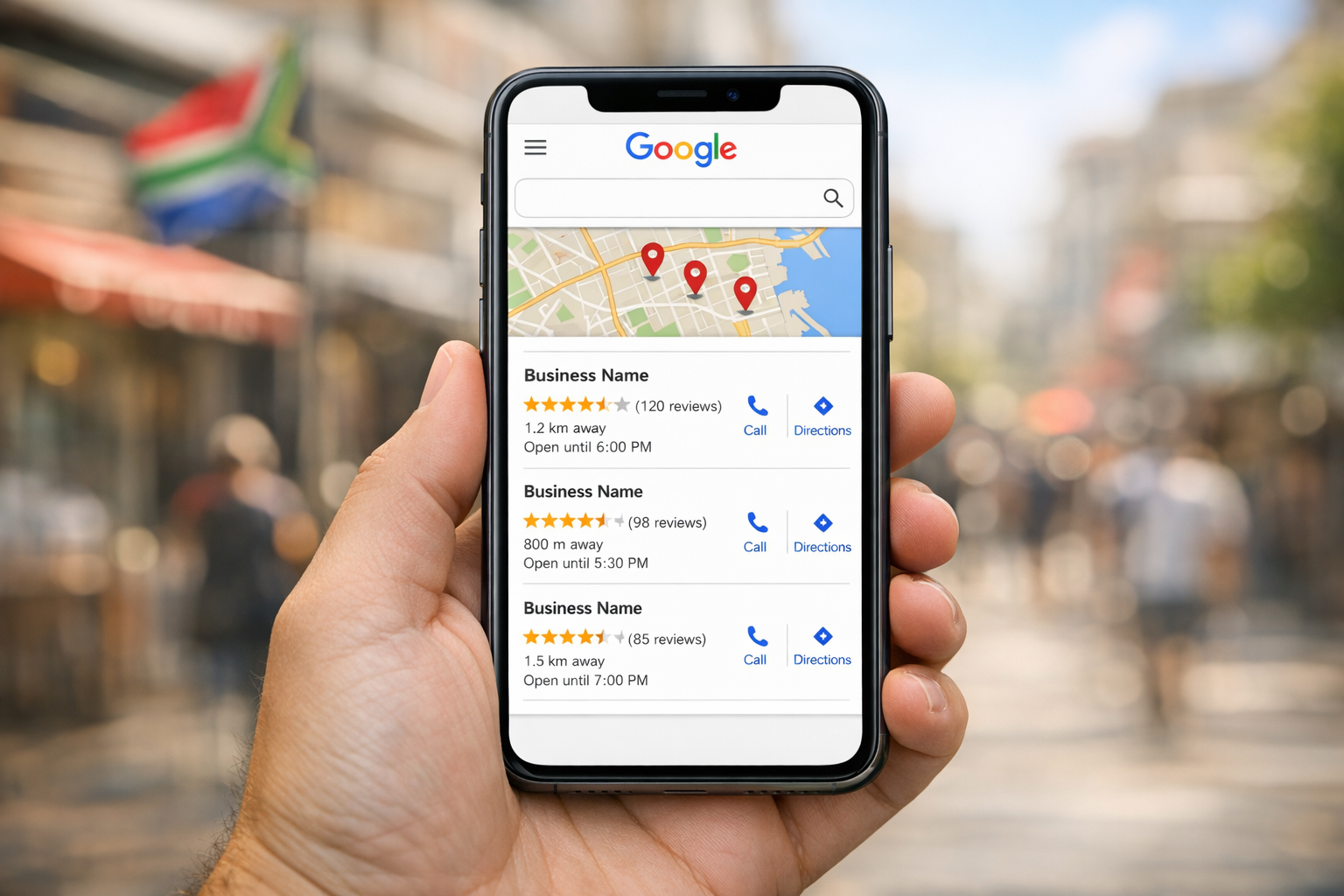
For businesses serving specific geographic areas in South Africa, local SEO is not optional - it is often the highest-ROI channel available. The local SEO audit evaluates every factor that influences your visibility in Google's local pack (the map results that appear for location-based searches) and local organic results.
Google Business Profile Optimisation
Your Google Business Profile (GBP) is the single most important local ranking factor. We audit your GBP for completeness (every field filled), accuracy (NAP consistency - Name, Address, Phone number matching your website exactly), category selection (primary and secondary categories aligned with your services), and content quality (description, posts, photos, Q&A). Many South African businesses have claimed their GBP but left it largely incomplete, missing out on the visibility that a fully optimised profile delivers.
Citation Consistency
We audit your business listings across South African directories and platforms - including Yellow Pages SA, Brabys, Hotfrog South Africa, HelloPeter, and industry-specific directories. Inconsistent NAP information across these citations confuses Google and weakens your local ranking signals. We document every inconsistency and provide exact corrections for each platform.
Review Profile Analysis
Google reviews directly influence local pack rankings. We analyse your review volume, average rating, recency of reviews, and response rate compared to local competitors. For South African businesses in competitive industries like legal, medical, or hospitality, a strong review profile can be the deciding factor between position one and position four in the local pack - and position four does not appear above the fold on mobile.
Local Content and Landing Pages
We evaluate whether your site has dedicated, optimised landing pages for each location you serve. A plumbing company serving Johannesburg, Pretoria, and Sandton needs separate, unique pages for each area - not a single generic service page. We audit existing location pages for content uniqueness, local keyword targeting, embedded maps, local schema markup, and internal linking from relevant service pages.
Local SEO Opportunity: South African local search is less competitive than markets like the US, UK, or Australia. Many local businesses have not invested in structured local SEO, meaning the barrier to ranking in the local pack is lower. Businesses that implement the findings from a local SEO audit typically see local pack visibility improvements within 30 to 60 days - significantly faster than organic ranking improvements for national terms.
Turning Audit Findings Into an Action Plan
An audit without an action plan is just a list of problems. The most critical part of the SEO audit process is translating findings into a prioritised roadmap that delivers measurable results within a defined timeline. This is where the experience of the auditing team matters most - knowing which fixes will move the needle and in what order.
The Impact-Effort Matrix
We categorise every finding using an impact-effort framework. Each issue is scored on two axes: how much ranking improvement fixing it will deliver (impact), and how much time and resource the fix requires (effort). This produces four categories:
- Quick Wins (High Impact, Low Effort): Title tag optimisation, meta description rewrites, fixing broken internal links, submitting an updated XML sitemap, adding missing canonical tags. These are implemented first - often within the first week.
- Strategic Projects (High Impact, High Effort): Content gap closure, page speed optimisation requiring code changes, backlink acquisition campaigns, site architecture restructuring. These are scheduled across 30 to 90 days.
- Incremental Improvements (Low Impact, Low Effort): Image alt text optimisation, schema markup additions, minor content updates. These are batched and completed during quieter periods.
- Long-Term Investments (Low Impact, High Effort): Platform migrations, complete content rewrites for low-traffic pages, link reclamation for low-authority domains. These are deprioritised unless they become strategically necessary.
Reporting and Benchmarking
Every audit concludes with a comprehensive report that includes: current ranking positions for all target keywords, a complete list of technical issues with severity ratings, content quality scores for every key page, backlink profile health metrics, competitive positioning data, and the prioritised action plan. This report serves as both a roadmap and a benchmark - we measure progress against these baselines at 30, 60, and 90 days post-implementation to quantify the impact of every change.
How Often Should You Audit Your Website
The frequency of SEO audits depends on the size and complexity of your website, the rate of content change, and the competitiveness of your industry. Here is a practical framework:
- Small business websites (under 50 pages): A full audit every 12 months, with quarterly spot checks on Core Web Vitals, indexation status, and Google Search Console errors.
- Mid-size websites (50 to 500 pages): A full audit every 6 months, with monthly monitoring of technical health, ranking positions, and backlink profile changes.
- Large eCommerce or content sites (500+ pages): A full audit every quarter, with weekly automated crawls and continuous monitoring through Google Search Console and third-party tools.
- After major changes: Any significant website change - platform migration, redesign, URL restructure, new CMS deployment - should trigger an immediate audit within 48 hours of launch. These are the highest-risk moments for ranking loss.
Google's algorithm updates continually, and your competitors are not standing still. A website that scored well in an audit six months ago may have developed new technical issues, fallen behind on content quality, or lost backlink authority relative to competitors who have been actively building. Regular auditing is not optional for businesses that depend on organic search for revenue - it is the mechanism that ensures sustained ranking performance.
At NexusSEO, we include ongoing audit cycles as part of our retainer engagements. Every client receives quarterly technical health checks, monthly ranking and traffic reports, and immediate alerts when Google Search Console flags new issues. This continuous audit approach means problems are identified and resolved before they impact rankings, rather than discovered months later during an annual review.
Frequently Asked Questions
A comprehensive SEO audit typically takes between 5 and 15 business days depending on the size and complexity of the website. A small brochure site with 20 pages can be audited in under a week. A mid-size eCommerce site with 500 to 2,000 product pages requires 10 to 12 days. Enterprise sites with tens of thousands of URLs can take two to three weeks for a thorough crawl analysis, content review, backlink assessment, and competitive benchmarking.
A professional SEO audit uses a combination of free and paid tools. Core tools include Google Search Console for indexation and performance data, Google Analytics for traffic and behaviour analysis, Screaming Frog SEO Spider for technical crawling, Ahrefs or SEMrush for backlink analysis and competitive research, and Google PageSpeed Insights for Core Web Vitals assessment. Supplementary tools include Surfer SEO for content gap analysis and BrightLocal for local SEO auditing.
SEO audit pricing in South Africa varies widely based on scope and agency expertise. Basic automated audits can be generated for free using tools like SEMrush but lack strategic interpretation. Professional manual audits from experienced agencies typically range from R5,000 to R25,000 depending on site size and depth of analysis. At NexusSEO, we offer a complimentary initial audit covering 50+ ranking factors to help businesses understand their current position before committing to any engagement.
You can perform a basic SEO audit yourself using free tools like Google Search Console, Google PageSpeed Insights, and the free version of Screaming Frog. These tools will surface technical errors, indexation issues, and performance problems. However, the interpretation of findings and strategic prioritisation of fixes requires experience. A self-audit is a good starting point, but a professional audit turns raw data into a growth roadmap with measurable ROI.
After the audit is complete, findings are compiled into a prioritised action plan organised by impact and effort. High-impact, low-effort fixes are addressed first - these often include technical errors like broken redirects, missing canonical tags, or unoptimised title tags. Medium-term actions involve content improvements and backlink outreach. Long-term initiatives cover content gap closure and competitive positioning. At NexusSEO, we present findings in a clear report with specific recommendations, expected impact estimates, and implementation timelines.
About NexusSEO
We're a Durban-based SEO agency serving South African businesses and agencies. Specialising in eCommerce and professional services SEO across KwaZulu-Natal, Gauteng, and the Western Cape.
Learn More About UsRelated Articles
Technical SEO
Technical SEO Checklist: 50 Things Google Cares About
The complete 50-point technical audit framework for every ranking factor.
Technical SEO
Core Web Vitals & Page Speed: The South African Guide
Core Web Vitals, Lighthouse scores, and the fastest speed optimisations.
Local SEO
How to Rank Local SEO: Complete 2026 Guide
Local pack dominance through GBP, citations, and review management.
Get Your Free SEO Audit
Discover exactly what's holding your website back. Our comprehensive audit covers 50+ ranking factors.
REQUEST FREE AUDITLatest From Our Blog
Get Your Free SEO Audit
Submit your details and we'll analyse your website's SEO performance within 24 hours.